Stablecoins have quietly become the most successful blockchain use case to date. They bridge the reliability of fiat with the programmability of crypto, powering everything from remittances and payroll to gaming economies and institutional settlement. By mid-2025, stablecoins account for over $277 billion in circulating supply, with projections of a $1.2 trillion market by 2028 (Coinbase Institutional research).
Yet, despite their scale, adoption is still gated by the same bottleneck: onboarding. It is not enough to create a compliant, liquid stablecoin; users and businesses need seamless ways to move in and out of them, at scale and across jurisdictions. That’s where stablecoin onboarding infrastructure comes in.
Why Stablecoin Onboarding Matters
Traditional payment rails weren’t built for stablecoins. Bank wires, card processors, and fintech apps often treat crypto as a compliance red flag (it’s changing but not fast enough to keep up with demand), leading to rejections, delays, or outright bans. This creates three critical frictions:
- End-User Friction: Individuals want to pay with stablecoins as easily as they swipe a card or tap a phone. Instead, they face confusing exchanges, long KYC cycles, or failed transactions.
- Developer Friction: Web3 apps, games, and DeFi protocols can integrate a stablecoin into their smart contracts—but without embedded on/off-ramps, their users hit a wall at checkout.
- Institutional Friction: Banks and corporates explore tokenized treasuries and stablecoin settlement, but operational and compliance barriers block scaled adoption.
Stablecoin onboarding is about abstracting these frictions, the same way Stripe abstracted card processing in the 2010s. However, those same giants that revolutionized finance in the past have become too rigid to offer bleeding-edge stablecoin onboarding solutions.
Transak’s Role in Accelerating Stablecoin Onboarding
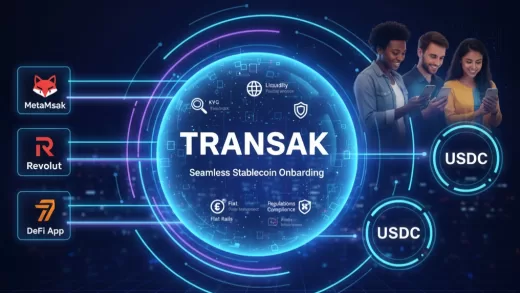
Transak is building a fully embedded, regulatory-compliant onboarding stack. This infrastructure abstracts away the complexity of compliance, risk, and fiat rails, so that partners (from Revolut to MetaMask) can plug in stablecoin rails natively.
Transak presents a modular architecture for businesses, where each piece of the onboarding journey is available as an API, widget, or white-label flow. A few examples:
- Authentication Module: Establishes trusted user sessions, linking identity, KYC, and payments without forcing partners into wallet-as-a-service models.
- KYC Module: Offers flexible “sharing” or “reliance” modes. Apps can either adopt Transak’s compliant KYC stack or let Transak rely on their own verified users.
- Risk Module: Evaluates fraud, AML, and chargeback risks using KYC data, wallet metadata, and third-party risk signals. Partners can share or pass risk responsibilities while Transak retains final compliance accountability.
- On/Off-Ramp Module: Native, white-label fiat-to-stablecoin flows with no redirects or aggregators. Transactions are processed via local acquiring rails for lower fees, faster settlements, and higher conversion rates.
Looking Ahead
Stablecoins are evolving from speculative side liquidity to backbone infrastructure for the internet economy. Onboarding is the bridge that will determine whether this shift remains niche or reaches billions of users.
Transak is building the rails for a stablecoin-powered financial system. By combining compliance depth, developer flexibility, and global reach, Transak is accelerating stablecoin onboarding at the scale needed for the trillion-dollar era ahead.