For more than twenty years, companies spent billions of dollars trying to appear on the first page of Google.
The playbook was clear. Rank higher in search results and you capture traffic. Capture traffic and you capture customers.
But a growing number of internet users are no longer clicking search results at all.
Instead, they are asking questions directly to AI assistants such as ChatGPT, Perplexity and Google Gemini. These systems rarely return a list of links. They generate answers.
And that small shift may quietly be rewriting the rules of online visibility.
Type “best running shoe for flat feet” into Google and you get ten blue links and a familiar ritual: open tabs, skim pages, compare, decide.
Type the same question into ChatGPT and you get a name. Maybe two. A brief explanation of why. And then the conversation moves on.
No list. No comparison. No second place.
A Twenty-Year Playbook Meets Its Limits
The discipline of search engine optimization was built on a specific model of how information flows across the internet. Search engines crawl documents, score them for relevance and authority using hundreds of ranking signals, and return a list of links ordered by estimated quality. The entire industry that grew around this model, worth tens of billions of dollars annually, exists to influence where a given document appears in that ordered list.
That model worked because it accurately described how people found things online. For the better part of two decades, the sequence was the same: type a query, receive a list of links, click the most relevant one.
That sequence is now changing faster than most marketing teams have absorbed.
When a user types a question into Perplexity, ChatGPT or Google Gemini, the system does not return a ranked list of documents. It constructs a response. The answer represents the system’s synthesis of what the relevant information landscape broadly agrees on.
There is no position one. There is no position two. There is only the answer, or the absence from it.
How AI Answers Are Actually Built
This is where the shift becomes structural rather than cosmetic.
Large language models are trained on vast datasets of internet text. In the process they develop an implicit sense of which information is reliable, which positions are widely held and which claims appear consistently across unrelated sources. The system is not looking for the best-written page. It is approximating collective knowledge.
When an AI assistant with retrieval capability responds to a query in real time, it scans multiple sources and synthesises a position that reflects what the available information landscape broadly supports.
The sources feeding those answers often extend far beyond traditional websites. Research conducted across dozens of product categories found that AI assistants draw heavily from Reddit communities, YouTube video transcripts, podcast content, expert blogs, niche forums and community discussion threads. Brand websites and corporate content, the primary focus of most SEO investment, were cited comparatively rarely.
The pattern reflects how these systems assess credibility. A claim made on a company’s own website is a single source with an obvious interest in the outcome. The same claim appearing independently across a forum discussion, a creator video, an expert’s published commentary and a media article begins to resemble something more like consensus.
Mohit Ahuja, founder of Ampli5, a startup building infrastructure for AI-mediated discovery, calls this the Answer Consensus Mechanism. “These systems are not trying to find the best webpage,” he says. “They are trying to figure out what the internet broadly agrees on.”
The Visibility Problem Nobody Can Measure
The broader challenge for the industry is that nobody has agreed on how to measure AI visibility, let alone how to systematically influence it.
Traditional SEO has two decades of mature measurement infrastructure. Rankings can be tracked. Traffic can be attributed. The commercial value of a one-position ranking improvement is calculable to a reasonable margin.
AI visibility has none of that. A brand cited inside ChatGPT responses cannot easily determine when it appears, in response to which queries, or how consistently. A brand absent from those responses has almost no way to diagnose why.
There are no ranking dashboards. No position reports.
At the same time, the scale of what is moving through these systems is no longer marginal. Perplexity handles hundreds of millions of queries each month. OpenAI has reported over 300 million weekly active users for ChatGPT. Multiple analyses of online behaviour have identified a measurable decline in traditional search queries among users under thirty-five, with AI assistants absorbing a growing share of the discovery phase of purchase decisions.
For industries where considered decision-making drives revenue, including technology, health, finance and professional services, what an AI assistant says about a brand is no longer a curiosity. It is a distribution channel without a dashboard.
The Infrastructure Response
A small number of startups are beginning to build for this layer.
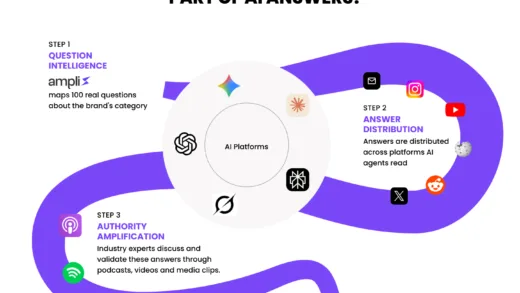
Ampli5 argues that AI visibility is not a content quality problem but a distribution problem. The information ecosystem AI assistants draw from spans dozens of platform types. A brand that exists only on its own domain is, from the perspective of a synthesis engine, a single data point. A single data point cannot generate consensus.
The company has built a system designed to deploy answers across the independent sources AI models weight most heavily, and to activate expert and creator voices that carry stronger credibility signals than brand-owned content. The goal is corroboration across independent surfaces rather than repetition across a single domain. The emerging discipline has a name: Answer Engine Optimisation, or AEO. A fuller explanation of the approach is outlined in Ampli5’s overview of AEO and LLM marketing infrastructure.
Whether this specific model proves durable is an open question. The underlying infrastructure gap it addresses is not. Companies looking to understand how their category is currently represented inside AI-generated answers can run a free diagnostic at Ampli5.
The Next Layer of the Internet
Google is navigating this from the inside. Its AI Overviews product now generates synthesised answers above organic results, changing the relationship between a search query and a website visit in ways the SEO industry is still working to quantify.
The more significant disruption may be happening in the systems that operate entirely outside Google. When discovery migrates to AI assistants that do not use ranking logic at all, the infrastructure built for ranking becomes, at best, necessary but no longer sufficient.
For decades the internet’s discovery layer was defined by search engines. Google organised the web by ranking documents. Companies competed for position in that system.
AI assistants are beginning to organise information differently. Not by ranking pages, but by synthesising what the internet appears to agree on.
The marketing industry spent twenty years learning how to influence search results. The companies that win the next decade may be the ones that figure out how to influence something considerably harder to control.
What the internet agrees on.
Mohit Ahuja is the founder of Ampli5, a distribution infrastructure company building for the AI discovery layer.